




Superfund Research Program
Mechanism Linking Preconception Arsenic Exposure and Diabetes in Offspring Revealed
Release Date: 05/12/2025
 subscribe/listen via iTunes, download(8.7MB), Transcript(172KB)

By Addie Lopez
Highlights
- Exposure to arsenic before conception can trigger changes that are passed down to the next generation.
- Key changes in paternal sperm DNA were reflected in their offspring, particularly among males.
- These changes may explain how preconception exposure to arsenic leads to disease in offspring, including diabetes.
Research Summary
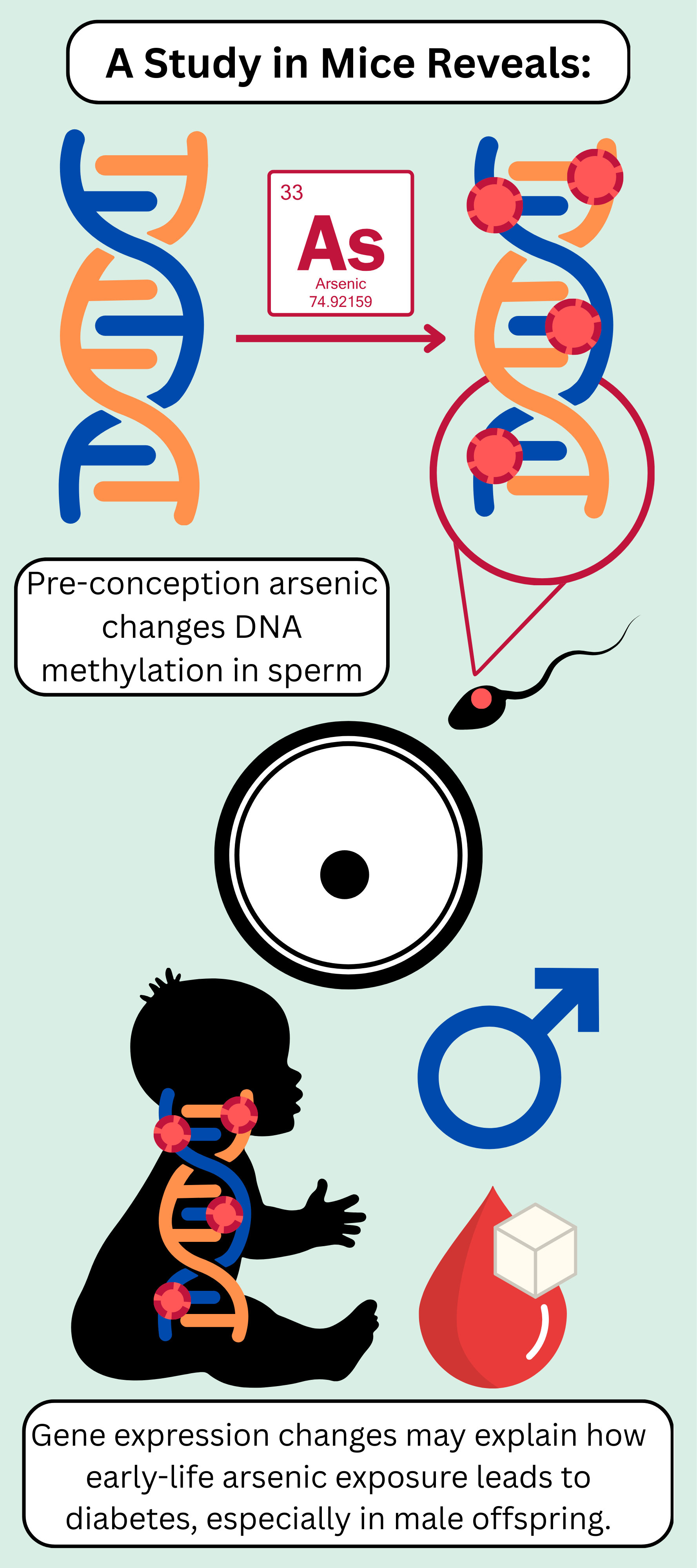
Exposure to inorganic arsenic before conception can trigger changes in gene activity that are passed down to offspring and increase their risk of developing diabetes, according to a study in mice funded by an NIEHS individual research grant and by the NIEHS Superfund Research Program (SRP). These changes, known as epigenetic changes, alter how genes work without changing the genes themselves. In this study, the researchers looked at a type of change called CpG methylation.
"Our previous studies with co-lead Mirek Stýblo, Ph.D., linked preconception arsenic exposure with differences in gene expression and diabetes in offspring," said University of North Carolina at Chapel Hill SRP Center Director Rebecca Fry, Ph.D. "We wanted to dig deeper and explore if heritable changes in CpG methylation could be a mechanism by which this occurs."
Following the Epigenetic Trail
The team exposed adult male and female mice to inorganic arsenic in drinking water for ten weeks prior to mating. They then examined DNA methylation patterns across the entire genome - an organism's complete set of DNA - in both paternal sperm and in the livers of their adult offspring.
They explored differences in CpG methylation and levels of expression among genes that are known to be associated with diabetes as well as in imprinted genes. Normally, offspring inherit two copies of each gene - one from each parent - and both can be expressed. But, in imprinted genes, only one copy -either the maternal or paternal - is expressed while the other one is turned off.
"Imprinted genes are particularly susceptible to environmental factors because only one copy of the gene is functional," said Fry. "Imprinted gene expression is tightly regulated by CpG methylation, so if arsenic exposure alters methylation in these genes we would expect important consequences for expression."
Documenting Differences and Similarities
Results showed that male mice exposed to arsenic before conception had altered CpG methylation in their sperm. Most affected genes had less methylation than usual - called hypomethylation - and more than half of these changes were associated with increased gene expression. These findings were similar in the livers of male and female offspring, though the largest percentage of differentially expressed genes with altered methylation occurred in males.
In many cases, the same genes that showed changes in paternal sperm were also affected in the offspring, and in exactly the same CpG sites. These changes occurred in several imprinted genes as well as in genes known to be involved in diabetes. For example, in male offspring, an important imprinted gene called Kcnq1 was hypomethylated and had increased expression. This gene is important in regulating insulin secretion. Impaired insulin secretion, along with resistance to insulin, is a key marker of diabetes. Similarly, these animals had differentially methylated and expressed Pola1, a gene known to be associated with diabetes.
"These findings show that exposure to inorganic arsenic before conception can alter DNA methylation in a way that can be passed down across generations," Fry explained. "The more pronounced changes in male offspring and the specific genes involved help explain sex-specific differences in arsenic-induced diabetes observed in previous studies."
The team is continuing to examine the role of epigenetic inheritance related to diabetes in two consecutive generations of offspring.
Impact Statement
"There is strong evidence linking arsenic exposure and diabetes in humans, and our previous studies have identified preconception as a critical window of susceptibility," said Fry. "This is the first study to show that heritable epigenetic changes from preconception arsenic exposure are a key underlying mechanism."
For More Information Contact:
Rebecca C Fry
University of North Carolina-Chapel Hill
Department of Environmental Sciences and Engineering
140 Rosenau Hall, CB #7431
Chapel Hill, North Carolina 27599
Phone: 919-843-6864
Email: rfry@email.unc.edu
To learn more about this research, please refer to the following sources:
- Hartwell HJ, Shang B, Douillet C, Bousquet A, Liu T, Zou F, Ideraabdullah FY, Styblo M, Fry RC. 2025. Heritable dysregulation of DNA methylation may underlie the diabetogenic effects of paternal preconception exposure to inorganic arsenic in C57BL/6J mice. Toxicol Appl Pharmacol 496. doi:10.1016/j.taap.2025.117242 PMID:39894169 PMCID:PMC11846692
To receive monthly mailings of the Research Briefs, send your email address to srpinfo@niehs.nih.gov.