National Institute of Environmental Health Sciences Superfund Research Program News and Highlights

|
|
June 05, 2026 (Issue 10)
|
|
This month in NIEHS Superfund Research Program news and highlights:
|

|
|
Dual-Action Bioaugmented Sorbents Optimize Groundwater Cleanup
Research Brief 374
Highlights
-
Researchers developed a modeling framework to accurately predict how activated carbon impacts the microbial degradation of tough organochloride pollutants.
-
The technology proved that combining carbon sorbents and bacteria efficiently degrades pollutants, resulting in greater net contaminant removal than traditional water treatments.
-
The study identified that vitamin supplementation can overcome some limitations of the systems and can prevent costly treatment failures.
To catch up on all past Research Briefs, visit the SRP website.
|

|
|
Research and Tribal Partnerships Advance Solutions for Uranium Mine Exposures
The legacy of uranium mining in the Southwest remains a major environmental health problem for Tribal communities. Although mining ended decades ago, waste from these sites continues to affect the environment and people living nearby. The University of New Mexico SRP Center was created to study these exposures and their health effects. The center brings together environmental scientists, engineers, biomedical researchers, and community engagement specialists to understand how metal mixtures move through the environment, how they affect the body, and how to reduce associated health risks.
See all the SRP Public Health Impact Stories on our website.
|

|
|
|
Jitka Becanova, Ph.D., began her work on PFAS as a trainee at the University of Rhode Island SRP Center, where she developed new tools to detect PFAS in aquatic environments. Today, Becanova is an Assistant Research Professor of Oceanography and through her research, she continues to collaborate with her former SRP mentors to push the boundaries of PFAS science.
SRP-funded researchers from Texas A&M University found that computer models can more accurately predict how quickly the kidneys remove various PFAS compounds from the body when paired with experimental data.
SRP-supported researchers at North Carolina State University reviewed several statistical methods of analyzing complex chemical mixtures to help scientists choose the best method for their specific research needs.
Researchers from the University of Iowa SRP Center identified three specific building materials as primary sources of polychlorinated biphenyl emissions in Vermont schools.
Scientists at the Massachusetts Institute of Technology SRP Center developed the SpheroidChip, a novel platform for rapidly testing DNA damage.
To catch up on all the latest in SRP News, visit the SRP website.
|
|
|
|
Superfund Hazardous Substance Research and Training Program (P42) Notice of Funding Opportunity (NOFO)
- The most recent P42 RFA was released on May 19, and the first application deadline will be September 25, 2026. For materials related to RFA-ES-27-004, please see the SRP Funding Opportunities webpage. SRP also hosted a webinar to provide information and answer questions about the P42 RFA. The archived recording is available to view on the CLU-IN website.
Register Now! SRP Progress in Research Webinar July 16
- The last session in our summer Progress in Research webinar series, titled SRP Multiproject Center Grants: Research Across Disciplines, is July 16 at 3:00 p.m. ET. This session will feature presentations from Baylor College of Medicine, University of Arizona, and University of Iowa. To register, visit the SRP webinars webpage.
|

|
|

|
- A study by the Texas A&M University SRP Center found that PFAS can be transferred from mother dolphins to their nursing calves, adding to the evidence that these persistent contaminants can be transferred from mothers to offspring during early development.
- A systematic review by the Oregon State University SRP Center identified effective approaches for communicating research results to participants, emphasizing clear language, visual formats, and multimodal delivery. Published in Environmental Health, the study was selected as an Editor's Choice, highlighting its contribution to advancing best practices in research translation.
- Researchers at the Baylor College of Medicine-Rice University SRP Center developed a new technique that uses nanoparticles and machine learning to detect and identify individual chemicals in complex mixtures without needing to separate them first. This approach speeds up analysis of contaminated sites by enabling faster, on-site detection of hazardous pollutants, improving the efficiency of environmental monitoring.
|

|
|
|
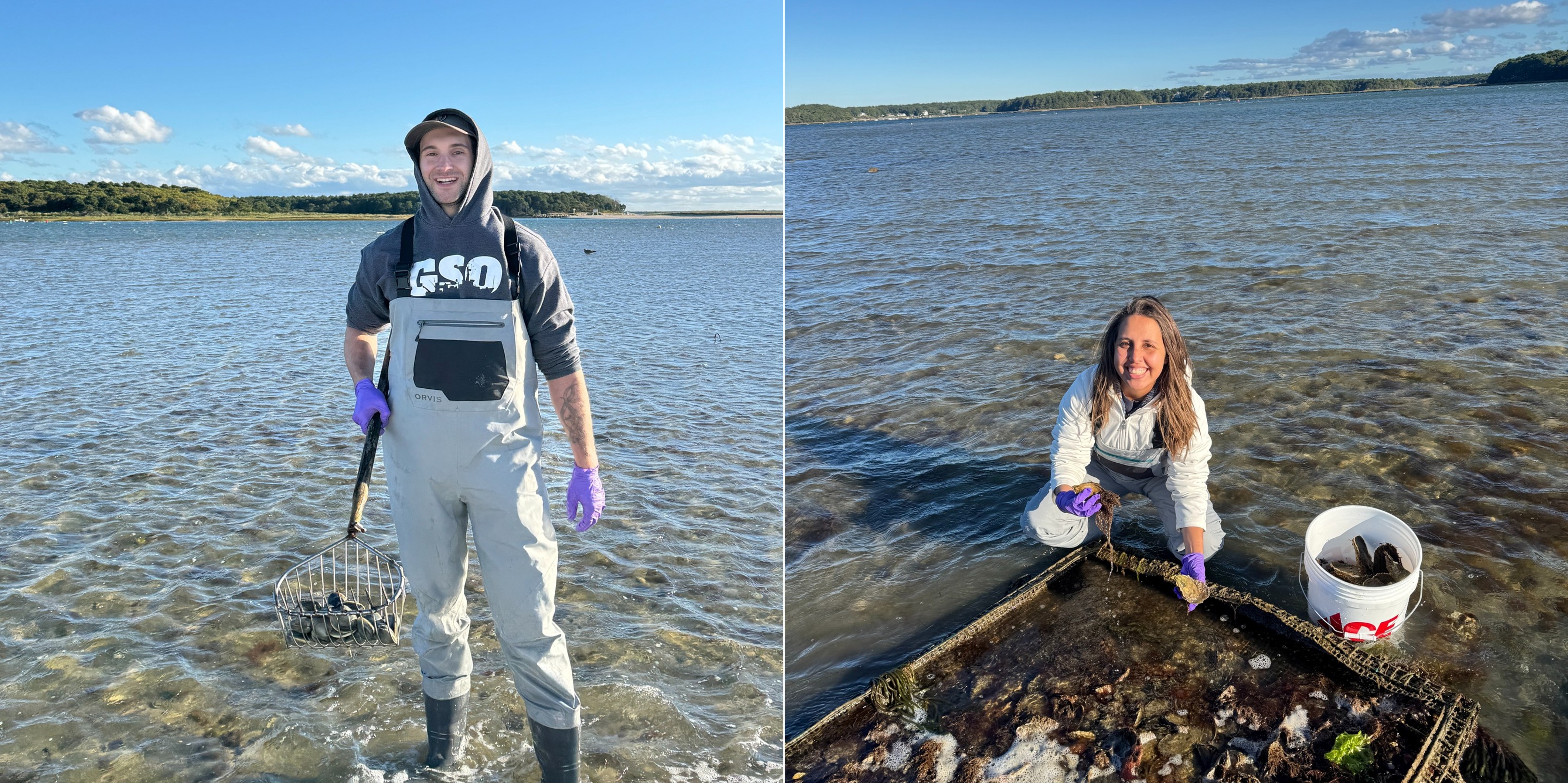
University of Rhode Island SRP Center trainees Justin Sankey (left) and Paola N. Román Morales (right) sample surface waters, fish, and shellfish in Cape Cod, Massachusetts, in collaboration with the Mashpee Wampanoag Tribe Natural Resource Department and Yarmouth Division of Natural Resources. The goal of this study is to determine the extent of PFAS contamination in Cape Cod’s surface waters and culturally significant food sources for the Mashpee Wampanoag Tribe. (Photo courtesy of the University of Rhode Island).
|
|
|
|
Visit Us
|
|
|